L-Citrulline
Nitric oxide precursor for blood flow and endurance
About L-Citrulline
L-Citrulline is a naturally occurring amino acid first isolated from watermelon. Unlike many amino acids that serve primarily as protein building blocks, L-Citrulline's most significant physiological role is as a precursor in the nitric oxide (NO) pathway. In the body, L-Citrulline is converted into L-Arginine, which in turn is used by nitric oxide synthase enzymes to produce nitric oxide — a gaseous signaling molecule that causes smooth muscle in blood vessel walls to relax, producing vasodilation and increased blood flow.
Why Alive 4 Health Uses L-Citrulline
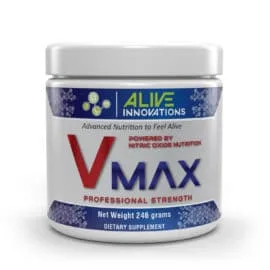
L-Citrulline is the primary nitric oxide precursor in V Max, alive4health's comprehensive cardiovascular and performance formula. Rather than relying on L-Arginine alone — which has documented absorption limitations — alive4health chose L-Citrulline because of its superior ability to raise plasma arginine and NO levels. In V Max, L-Citrulline works synergistically with Nitrosigine, CoQ10, Hawthorn Berry, and Beet Powder through multiple reinforcing pathways.
Why L-Citrulline Is More Effective Than L-Arginine For Nitric Oxide
L-Citrulline is more effective at raising blood L-Arginine levels than supplemental L-Arginine itself, because arginine taken orally is rapidly broken down by the enzyme arginase in the intestine before reaching systemic circulation. L-Citrulline bypasses this first-pass degradation and is converted to L-Arginine in the kidneys with much higher efficiency, resulting in sustained elevations of plasma arginine and nitric oxide.
L-Citrulline For Cardiovascular Health And Physical Performance
Research supports L-Citrulline's ability to improve muscular endurance, reduce the sensation of fatigue during high-intensity exercise, lower post-exercise soreness, and contribute to healthy blood pressure — all through the common thread of improved nitric oxide production and vascular function. By increasing nitric oxide and promoting vasodilation, L-Citrulline enhances blood flow to working muscles during exercise, delivering more oxygen and nutrients while facilitating the removal of metabolic waste products.
Showing the single result